



health
Progress against secondhand smoke
■ An occasional snapshot of current facts and trends in medicine.
Quick View. Posted Aug. 7, 2006
A June 27 Surgeon General's report concluded that even brief exposure to secondhand smoke can cause harm, and the only means of shielding nonsmokers is to eliminate indoor smoking.
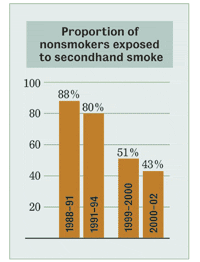
Evidence also indicates progress against secondhand exposure.
The National Health and Nutrition Examination Survey III, conducted from 1988 to 1994, was the first study to examine secondhand smoke exposure. It examined the U.S. population ages 4 through 74 from 1988 to 1991 and from 1991 to 1994. In 1999, the National Center for Health Statistics resumed NHANES' representative samples.
Cotinine levels reflect tobacco smoke exposure within two to three days and, therefore, represent patterns of usual exposure.
The study found detectable levels of serum cotinine (greater than or equal to 0.05 nanograms per milliliter) among nearly all nonsmokers during 1988 to 1991. Exposure among nonsmokers had declined to less than half of nonsmokers by 2001-02.
Exposure to secondhand smoke varied across demographic groups:
- During 1999-2002, 59.6% of children ages 3 to 11 had exposure, compared with 35.7% of older adults ages 60 to 74.
- Children ages 3 to 11 and young people 12 to 19 were more likely than adults to live in a household with at least one smoker.
- Racial and ethnic differences in secondhand smoke exposure were evident during all four periods. Mean exposure levels for non-Hispanic blacks were significantly higher than for Mexican-Americans and non-Hispanic whites. Mexican-Americans had the lowest levels.
So far, more than 2,200 communities nationwide -- in addition to 16 states and the District of Columbia -- have passed smoke-free laws.
Source: "The Health Consequences of Involuntary Exposure to Tobacco Smoke," a report by the Surgeon General, June 27


