



profession
H1N1 vaccine, once coveted, now ignored as public's fears fade
■ The CDC is urging doctors to continue vaccinating patients to prevent a third wave of flu, but physicians say few patients are interested.
By Christine S. Moyer — Posted Feb. 22, 2010
- WITH THIS STORY:
- » H1N1 numbers dropping
- » Related content
Daniel Hoffman, MD, can't seem to give away the once-coveted influenza A(H1N1) vaccine, which now sits in the refrigerator of his solo practice.
The Dunlap, Ill., general practice physician immunized only three patients during a recent week in February, compared with the approximately 30 a week he vaccinated at the epidemic's peak. It's not that he doesn't recommend the vaccine anymore; his patients no longer seem to want it.

Hugo Alvarez, MD, an internist and deputy medical officer at Access Community Health Network, says many of the network's Chicago-area clinics did not receive a sufficient supply of the influenza A(H1N1) vaccine until after the epidemic eased. "The reality is the number of [H1N1] cases have dropped. As the winter goes away, patient interest [in the vaccine] is fading very, very quickly." Photo by Ted Grudzinski / AMA
"When they decline, I say, 'Fine,' and document it in their charts," Dr. Hoffman said. "Everyone feels it's over. Their view is, 'If I don't hear about it on TV, it doesn't exist.' "
The nation's first wave of H1N1 activity began in the spring of 2009 and was followed by a second round in the fall. But since peaking in late October, reported cases of H1N1 have fallen precipitously nationwide. No states reported widespread activity during the five-week period ending Feb. 12, according to the Centers for Disease Control and Prevention. This contrasts sharply with the end of October, when H1N1 was widespread in 48 states.
CDC officials, however, emphasize that the virus is still circulating, and they say continued vaccination of the public is critical to prevent a third wave of flu outbreaks.
But some doctors say that despite the federal agency's warnings, interest has dwindled for many patients.
"We're sure hoping that [patients] are getting the vaccine. It's a little hard, though, at this point in time in Wyoming, when there is almost no H1N1 activity, to continue to promulgate that message," said Brent Sherard, MD, MPH, director and state health officer at the Wyoming Dept. of Health.
A Harvard School of Public Health poll released Feb. 5 found that nearly half of Americans surveyed from Jan. 20 to Jan. 24 believe the H1N1 outbreak is over. Only 18% believe another outbreak this year is "very likely."
The CDC insists it's too soon for such complacency.
"None of us knows whether we're going to have bursts of disease or clusters, or just ongoing transmission, as we've seen in the past few weeks. But the virus does continue to spread. And those who haven't been vaccinated are still vulnerable to harm," Anne Schuchat, MD, director of the CDC's National Center for Immunization and Respiratory Diseases, said during a Feb. 5 news briefing.
Vaccination challenges
At the briefing, the CDC reported that 155 million doses of H1N1 vaccine had been shipped for distribution throughout the U.S. and about 70 million doses had been administered. Dr. Schuchat said she was encouraged by the Harvard poll findings that 21% of adults had received the vaccine, and 16% intended to get it in February.
The reality for many physicians and public health officials, however, is that doses desperately needed months ago are now piling up with no takers. Complicating matters, about 12 million doses of Sanofi Pasteur's monovalent H1N1 vaccine expired on Feb. 15 because the vaccine did not maintain potency as long as expected.
These Sanofi Pasteur doses had been shipped to states for allocation between November 2009 and January 2010, and most were administered to patients. The CDC said there are no safety concerns, but physicians and others were ordered to discard any remaining doses or return them to the manufacturer.
For some doctors, the recall added one more hurdle to immunizing patients.
"When the little bit of news you get says a vaccine is getting recalled, it makes it that much more difficult to get people who aren't that enthusiastic into the clinic to be vaccinated," said Donald Murphey, MD, medical director of pediatric infectious disease at Cook Children's Medical Center in Fort Worth, Texas.
H1N1 surfaced in the U.S. in April 2009, and the CDC estimates that about 57 million Americans had been infected as of Jan. 16. About 257,000 were hospitalized, and 11,690 died.
At the height of the epidemic, pediatrician David L. Peterman, MD, said his medical group in Idaho received 300 to 400 vaccine doses at a time, but each allotment only lasted a few days. He said with employees ill with H1N1, clinics were short-staffed, and changing information from the CDC left physicians unsure of how to handle the epidemic.
"I took care of children who I admitted to the hospital. There were adults in our clinic who died," said Dr. Peterman, president of Primary Health Medical Group, which has multiple clinics in Idaho. "I've been through other seasonal flu epidemics, and this one was big."
At Cook Children's Medical Center, staff and health professionals transformed a board room into a waiting room for hundreds of patients with H1N1 symptoms. The center ran low on masks and antiviral medications.
In the Chicago-area clinics of Access Community Health Network, staff instituted quick triaging in waiting rooms, enabling patients to self-identify possible H1N1 symptoms. Staff also redirected supplies from less-impacted offices to those harder hit by the epidemic, said internist Hugo Alvarez, MD, the health network's deputy medical officer.
Dr. Alvarez believes a third wave of H1N1 is likely. The question, he said, is whether the virus will mutate.
"It doesn't matter if the wave is very big, as long as the treatment is very effective. But if the [vaccine] is not effective, then we will face a challenge we will not be able to handle," he said.
For now, the CDC, along with physicians and public health officials, are reviewing their responses to the epidemic and monitoring influenza activity for signs of another wave. The CDC is exploring ways to speed up vaccine production and improve detection of the virus.
In Idaho, Dr. Peterman hopes to speak with the state's health department about improving vaccine distribution to physicians for future epidemics. In Texas, Cook Children's Medical Center is examining ways to triage an even larger number of children during the next flu outbreak.
"It was a real epidemic, but it's not as bad as it could have been," Dr. Murphey said. "We should be learning from this and getting ready."
ADDITIONAL INFORMATION
H1N1 numbers dropping
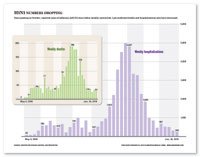
Click to see data in PDF.
Since peaking in late October 2009, reported cases of influenza A(H1N1) have fallen steadily nationwide. No states have reported widespread activity during the five-week period ending Feb. 12, according to the Centers for Disease Control and Prevention. Reports of lab-confirmed deaths and hospitalizations also have decreased since peaking in late October 2009. CDC officials, however, emphasize that the virus is still circulating and urge continued vaccination efforts to prevent a third wave of the epidemic.
| Week ending | Lab-confirmed deaths |
Lab-confirmed hospitalizations |
|---|---|---|
| May 9, 2009 | 2 | 85 |
| May 16, 2009 | 0 | 82 |
| May 23, 2009 | 7 | 115 |
| May 30, 2009 | 7 | 311 |
| June 6, 2009 | 11 | 586 |
| June 13, 2009 | 40 | 603 |
| June 20, 2009 | 39 | 836 |
| June 27, 2009 | 43 | 598 |
| July 4, 2009 | 40 | 470 |
| July 11, 2009 | 49 | 665 |
| July 18, 2009 | 39 | 217 |
| July 25, 2009 | 22 | 503 |
| Aug. 1, 2009 | 77 | 744 |
| Aug. 8, 2009 | 39 | 1,005 |
| Aug. 15, 2009 | 45 | 469 |
| Aug. 22, 2009 | 33 | 859 |
| Aug. 29, 2009 | 37 | 237 |
| Sept. 5, 2009 | 30 | 412 |
| Sept. 12, 2009 | 47 | 531 |
| Sept. 19, 2009 | 39 | 814 |
| Sept. 26, 2009 | 53 | 957 |
| Oct. 3, 2009 | 91 | 1,603 |
| Oct. 10, 2009 | 81 | 2,221 |
| Oct. 17, 2009 | 117 | 3,575 |
| Oct. 24, 2009 | 137 | 4,514 |
| Oct. 31, 2009 | 190 | 5,002 |
| Nov. 7, 2009 | 188 | 4,807 |
| Nov. 14, 2009 | 177 | 3,351 |
| Nov. 21, 2009 | 178 | 3,282 |
| Nov. 28, 2009 | 83 | 2,271 |
| Dec. 5, 2009 | 136 | 1,862 |
| Dec. 12, 2009 | 86 | 990 |
| Dec. 19, 2009 | 71 | 858 |
| Dec. 26, 2009 | 41 | 468 |
| Jan. 2, 2010 | 30 | 687 |
| Jan. 9, 2010 | 36 | 524 |
| Jan. 16, 2010 | 25 | 507 |
| Jan. 23, 2010 | 33 | 315 |
| Jan. 30, 2010 | 29 | 242 |
Source: Centers for Disease Control and Prevention


