



health
Doctors should be on lookout for dengue fever
■ With U.S. hospitalizations rising between 2000 and 2007, physicians are being asked to watch for trends of the disease.
By Christine S. Moyer — Posted April 25, 2011
- WITH THIS STORY:
- » External links
- » Related content
As cases of dengue infection escalate around the globe, authors of a new study are urging physicians to ask patients with fevers for travel histories. The mosquito-borne infection should be considered as a possible diagnosis for people who recently visited places where the disease is endemic, including Asia, the Caribbean, Central America and South America.
Doctors also should know the trends of the disease in the United States, the authors said.
Their study, published online April 13 in the Centers for Disease Control and Prevention's Emerging Infectious Diseases, found that more than three times as many people were hospitalized in the U.S. with dengue fever in 2007 than in 2000. Hospitalizations climbed from 81 cases in 2000 to 299 in 2007.
The study's authors attribute the increase, in part, to the growing number of worldwide dengue cases and the significant number of Americans who travel to areas where the disease is abundant. The global rise has been linked to climate change. Greater rainfall and warmer temperatures make it more conducive for infected mosquitoes to circulate.
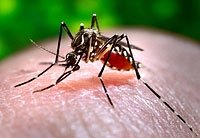
As the primary source of transmission of dengue fever and dengue hemorrhagic fever, an Aedes mosquito prefers to feed on human hosts. The mosquito frequently is found in tropical regions. Photo courtesy of James Gathany / CDC
"It's important for physicians to recognize who's at risk of dengue fever," said Judy A. Streit, MD, an author of the study. "Traditionally, [it has been people who] travel to disease-endemic areas."
But, she added, physicians should not rule out the disease in patients with a febrile illness who have not been outside the country recently.
"Travel is not the only risk factor. We do have the vectors present in the U.S.," said Dr. Streit, assistant professor in the Dept. of Internal Medicine in the Division of Infectious Diseases at the University of Iowa Carver College of Medicine in Iowa City.
For example, four people in February were infected with dengue fever near their home in Oahu, Hawaii, according to the Hawaii State Dept. of Health. In 2009, dengue fever re-emerged in Key West, Fla., with 85 infections reported to the Florida Dept. of Health from 2009 to 2010. Two other cases were diagnosed in neighboring counties.
These were the first dengue cases discovered in Florida since 1945, and all were acquired in the state, said Harold Margolis, MD, director of the CDC's Dengue Branch. As of April 14, there had been no reports of the disease in Florida this year.
For the study in Emerging Infectious Diseases, researchers used a database of U.S. hospital discharges to examine about 1,250 people hospitalized with dengue fever from 2000 to 2007. In finding that hospitalizations had tripled during the period, the study's authors said there probably were more people who were infected but not hospitalized.
"Our findings show that doctors in all parts of the country ... need to be aware of patients' travel histories and need to know what diseases are circulating in different parts of the country and the world," said Philip M. Polgreen, MD, senior author of the study. He is assistant professor in the Dept. of Internal Medicine in the Division of Infectious Diseases at the University of Iowa Carver College of Medicine.
Millions infected worldwide
As many as 100 million dengue infections occur throughout the world every year, the CDC said. About 500,000 people are hospitalized with the infection, and more than 20,000 die from it annually, according to the study in Emerging Infectious Diseases.
Less is known about dengue incidence in the U.S. because nationwide physician and hospital reporting of the disease was not implemented until 2010. That year, 70 cases of dengue fever were reported to the CDC. The CDC is working with states to improve reporting of dengue cases, as the number may be higher.
This year, there have been eight cases, according to the CDC. Four were reported in Pennsylvania, two in Washington and one each in Indiana and Wisconsin.
The disease is caused by any one of four viruses transmitted by the bite of an infected Aedes mosquito. Symptoms include a high fever, severe headache, pain behind the eyes and joints, and muscle and bone pain, the CDC said. People with the disease often have a rash and mild bleeding from the nose or gums.
Some people develop a more severe form of the infection called dengue hemorrhagic fever, which can be fatal. In this condition, patients often have a low platelet count and can experience vomiting, abdominal pain and difficulty breathing when their fever declines. This infection can lead to failure of the circulatory system and shock.
Diagnosing both forms of the disease can be complicated, because an antibody response to the infection is not detectable until three to five days after the onset of fever, according to the Food and Drug Administration. This can produce a negative test result even when a person has dengue fever.
On April 18, the FDA approved the first test to help diagnose dengue fever and dengue hemorrhagic fever. The test, which will be available for use in clinical laboratories, detects antibodies to the virus in blood samples from patients who have signs and symptoms of the infection.
The key for physicians to identify the disease accurately is being aware of it, Dr. Margolis said.
"If you have a patient coming back from [countries] in Asia and the Americas ... and that person has a febrile illness, you should be putting dengue on the top of your differential diagnosis list," he said.


