



profession
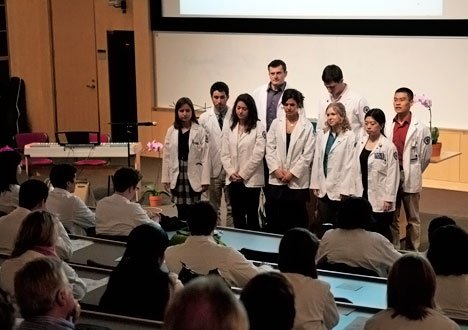
First-year medical students at Northwestern University Feinberg School of Medicine in Chicago sing of "studying about that good old way" during an a cappella version of the gospel song "Down to the River to Pray." Photos by Ted Grudzinski / AMA
Donor families join anatomy students at ceremony honoring their loved ones
■ Northwestern medical students sing, read essays and say thanks to the donors they learned from in class.
By Kevin B. O’Reilly — Posted May 26, 2011
- WITH THIS STORY:
- » Related content
In front of her fellow first-year medical students, Natsai Nyakudarika spoke about the difficulty she had looking at the face of her anatomy class cadaver, a man named Gerald.
"I can't look at Gerald's face," she said. "I'm afraid that I will see in it the face of everyone I've loved who has died."
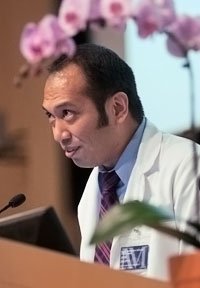
John Zulueta reads from "A Narrow Cut to the Interior Thorax: A Haiku Journal," an essay he wrote about his time in anatomy class. All Northwestern medical students are assigned to write about their dissection experiences as part of a medical humanities course.
Nyakudarika was among several students at Northwestern University's Feinberg School of Medicine in Chicago who talked about their experiences with dissection as part of the school's closing ceremony for its anatomy class.
Most medical schools now host such ceremonies, but Northwestern is unusual in that it invites cadaver donors' family members to attend.
"We never did that before last year," said Larry R. Cochard, PhD, who directs Northwestern's anatomy lab and helps organize the annual ceremony. "It's a whole different dynamic with the families here. We didn't know what to make of that, but it's been great."
Of the 29 cadaver donors honored, the families of six donors were present. Between performances of contemplative musical pieces drawn from pop, gospel and classical genres, students read from reflective essays they were assigned to write about one month after anatomy classes began last October.
Brandi Jackson read her essay, "Liars," about the complexity of the roles of the cadaver and the anatomy student.
"You fooled me," she said. "You masquerade as our cadaver, but are you not a man? And I pretend to be the expert dissector -- the one you imagined when you signed on the dotted line."
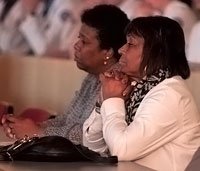
Rhonda McFarland, left, watches the anatomy class closing ceremony that honored her mother's donation along with family friend Francine Cummings. "I had some trepidation about coming," McFarland says. "You don't know what to expect. It was nice to hear the students and their reflections on the separate moments when they realized these were human beings before they were cadavers."
Student John Zulueta described how his group of six students decided who would make the first incision.
"Afraid to seem too eager, I let someone else make the first cut," he said.
A representative of each group of six students then walked to the podium and said a few brief words of thanks to the donor they worked with and placed a rose in a vase. A slide show of photos taken in the lab -- none of them capturing the cadavers -- was shown. Nearly all of the first-year medical students attended.
Family connection
Carl Ruzicka's mother, Martha, who died of renal failure just shy of 90, donated her body for anatomical education. Ruzicka did not know which school his mother's body was sent to until he was invited to the ceremony at Northwestern.
"I thought the ceremony was fantastic," said Ruzicka, who lives in the Chicago suburb of Highland Park. "I didn't think it was going to be such a personal experience. We didn't view our mom's death with any real sadness. It was her time. We were very proud of her.
"Today, this brought some tears because of how much pride we have in our mom. It was evident that the students were so appreciative of the donors. It was very touching."
Ruzicka also spoke with the students who worked with his mother's body and told them more about the maladies she endured.
Jan Roberts, MD, attended the ceremony to honor her sister, donor Michaele Roberts. She said anatomy educators' efforts to help students reflect on their dissection experiences and connect with donors' families marks a positive change from when she was in medical school.
"It's a good thing, because I think medical students may lose sight that this is a real individual who had a life and made a specific donation and was intent on giving something back," said Dr. Roberts, medical director at BlueCross BlueShield of Illinois. "It humanizes the physicians-to-be as well as gives the family a sense of closure."


