



profession
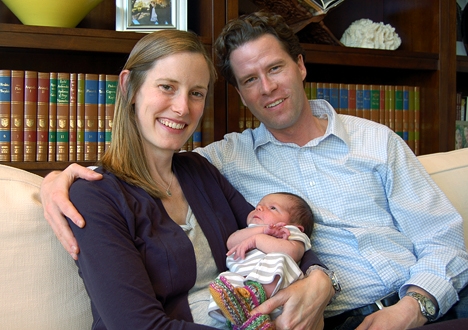
Olivia Katharine Seeley was born Sept. 19, the day before William Seeley, MD, was named a MacArthur fellow. "They have been my greatest source of pride and inspiration during this remarkable week," said Dr. Seeley, along with his wife, Hilary Seeley, MD, a pediatric resident at the University of California, San Francisco. Photo courtesy of Dr. Seeley
California neurologist wins MacArthur award
■ William Seeley, MD, is recognized for his work in human neurodegenerative disease. Research on suicide, stem cells and sports-related concussions also is honored.
From the window of his wife's hospital room, neurologist William Seeley, MD, watched the sun rise in the San Francisco sky as he cradled his newborn daughter.
The same day, the MacArthur Foundation announced that Dr. Seeley had received a $500,000 grant to use as he pleases.
"It was just incredibly heartwarming," he said of that Sept. 20 morning. "I got a number of congratulations and pats on the back. I couldn't have felt happier to be alive in that moment."
Dr. Seeley, 39, associate professor of neurology in the Memory & Aging Center and director of the Neurodegenerative Disease Brain Bank at the University of California, San Francisco, was among 22 people honored with a 2011 MacArthur Foundation fellowship.
The John D. and Catherine T. MacArthur Foundation awards $500,000 fellowships yearly to creative people who work in medicine, science and other fields. Winners are selected for the originality of their work and potential to make important contributions.
Dr. Seeley was recognized for his research in human neurodegenerative disease. He integrates microscopy, magnetic resonance imaging and clinical examination to explore the structural, functional and behavioral aspects of the disease. His primary concentration is front temporal dementia, which is second to Alzheimer's disease as the primary cause of progressive pre-senile dementia.
Neurodegenerative disease "teaches us an enormous amount about how the brain works," he said. "Every patient is a lesson in the organization of the brain. Because the population is aging, these diseases are becoming more prevalent."
A typical day for Dr. Seeley is spent analyzing tissue under a microscope and viewing brain imaging data on his computer. He also treats patients with neurodegenerative disease and regularly meets with families affected by the condition.
"We really try to focus on the neuro-anatomy of the disease. We're trying to understand what's going on at the microscopic level, the macroscopic level and at the behavioral level," he said. "My long-term goal is to help the field move toward treatment [and] to a cure."
Suicide, stem cells areas of focus
Dr. Seeley was the only physician to win a fellowship award, but others won for medical-related research.
Matthew Nock, PhD, 38, a psychologist and psychology professor at Harvard University, was honored for his study of suicide and self-injury in adolescents and adults. Nook combines epidemiology, laboratory experiments, measurement of implicit mental associations and other assessments to analyze why people harm themselves.
Another winner was Yukiko Yamashita, PhD, 39, a developmental biologist exploring the biochemical, structural and molecular genetic mechanisms that regulate stem cell division. She is a research assistant professor at the Life Sciences Institute in Michigan.
Kevin Guskiewicz, PhD, 45, a researcher and athletic trainer, was recognized for his work in the treatment and prevention of sports-related concussions. He was among the first to identify the long-term effects of multiple concussions, including cognitive impairment and depression, through large-scale epidemiological studies of retired professional football players.
Deciding how to use his $500,000 award won't be easy, Dr. Seeley said.
"Hopefully, we'll use it toward taking a few more chances with our research, taking on the links of the different levels of [disease] analysis," he said. "It's really challenging as a researcher to forge a bridge between the different levels. I think having this money without restrictions, it could enable us to try and do things that are a little riskier."


